
Why a French dub runs longer than the English original
The same sentence takes 15 to 20 per cent longer in French than in English. Something has to absorb that, and which thing it is decides how the dub sounds.
Radiance is an AI video translation and dubbing platform: it translates, dubs or subtitles your videos into 29 languages and publishes each version to TikTok, Instagram, YouTube and Facebook.
Record twenty seconds of English, translate it faithfully into French, and read it back at a natural pace. It will take roughly twenty-three seconds. Spanish lands about the same. German runs longer still in syllables, though often shorter in words. Japanese depends entirely on the register.
This is called expansion, and it is the hardest constraint in dubbing. The video is twenty seconds long. The new audio is twenty-three. Something has to give.
The four things that can give
There are only four, and every dubbing system picks among them.
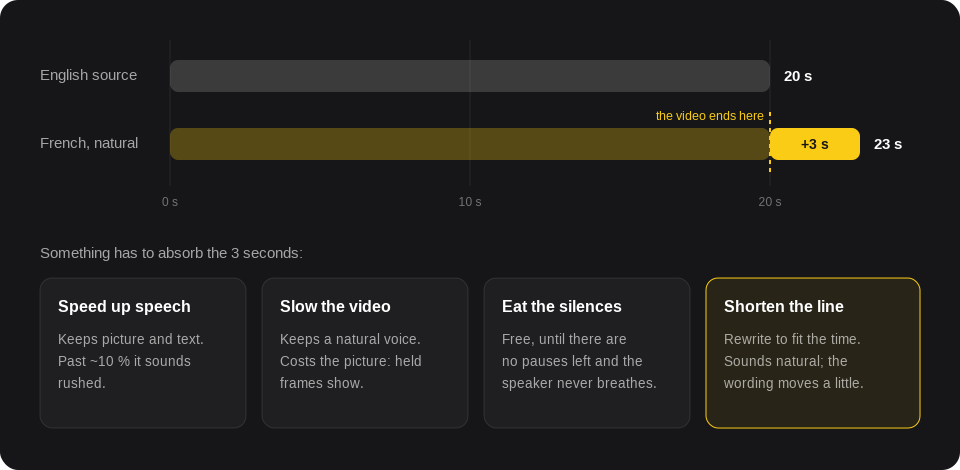
The speech speeds up. The video stays untouched and the translation stays faithful. The price is naturalness: past about 10 per cent, a listener hears rushing before they can say why, and past 20 per cent it sounds like the disclaimer at the end of a radio ad.
The video slows down or holds a frame. The voice stays natural. The price is the picture, and it is usually too high: a frame frozen mid-gesture is far more noticeable than a slightly quick voice.
Silence gets eaten. The pauses between sentences absorb the overflow. This one is free, which is why a video with natural breathing room dubs better than a dense one. It also runs out fast.
The translation gets shorter. The line is rewritten to fit the time available instead of being rendered as literally as possible. Good dubbing does this, and it is the one most people don't expect.
What a shorter translation means for you
The dub is a close paraphrase of what you said. "What I want you to take away from this is that consistency beats intensity" may come back as the French equivalent of "remember: consistency beats intensity." Same meaning, four words lighter, and it fits the shot.
For almost all content you will never notice, and the paraphrase is correct. There are exactly three cases where it matters:
- Numbers and claims. A rewritten line is still checked against the original meaning, but if your video states a price, a dosage, a legal condition or a guarantee, read the translated transcript before publishing. It takes two minutes and rules out the whole class of problem.
- Wordplay. A pun does not survive compression, and it rarely survives translation either. Assume it is gone and check whether the line still lands.
- Quotes. If you quote someone word for word and the exact wording is the point, flag it. A paraphrased quotation is a different claim.
How to shoot so it dubs well
You can't change the expansion rate, but you can change how much room there is to absorb it.
- Leave a beat between sentences. The half-second of silence you would cut for pace in your own language is half a second of headroom in every other one.
- Avoid hard sync points. A line timed to land exactly as something appears on screen is the hardest thing to dub. If the reveal has some slack around it, it will survive.
- Prefer short sentences. They give the translator more places to absorb overflow, and they read better anyway.
- Leave some seconds empty. A video with no silence has nowhere to put the extra time, so every second of overflow comes out of speech rate.
You would give the same advice to make a video easier to listen to in its own language, which is a good sign it is right.
Where the tiers actually differ
A standard dub has the words and your timbre. It holds the timing by managing the four levers above, and it does that well.
The more expensive tier pays for delivery. The pause you left before the punchline stays a pause, the rise on the question stays a rise, the dry line stays dry. The length constraint tends to flatten those first, because flattening them is the cheapest way to save half a second.
Both tiers speak in your voice. What the extra cost buys back is the half-seconds.